
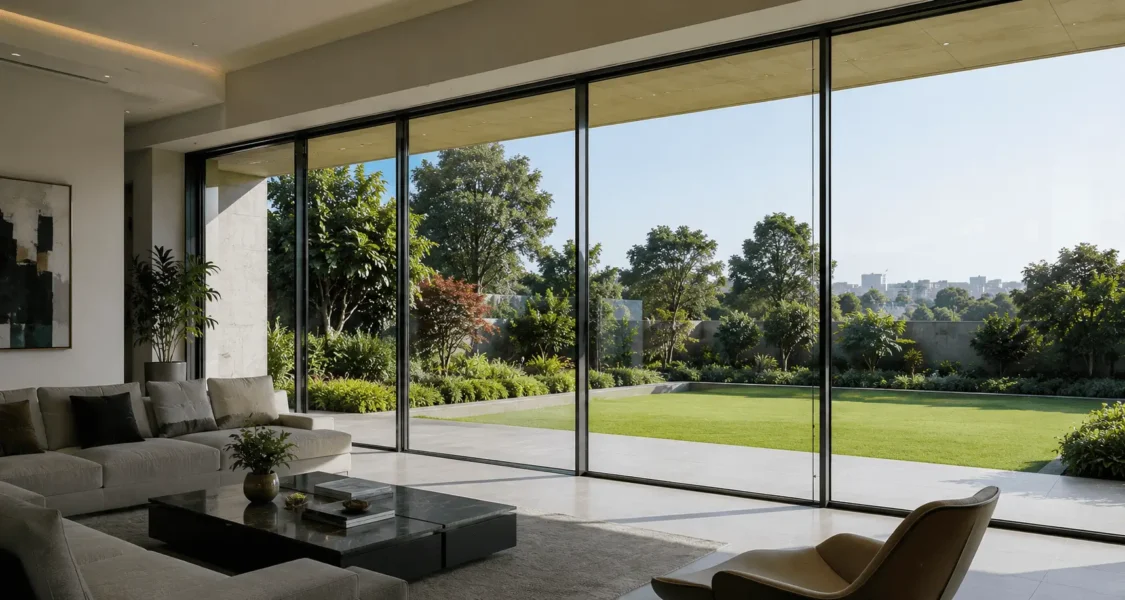
Every house with a good view eventually arrives at the same ambition. Take the wall out. Put glass there instead. Let the room open onto the garden, the terrace, the water, whatever the house was positioned for in the first place.
It is one of the few architectural moves that still feels generous rather than fashionable. It is also the one where the gap between a beautiful result and a disappointing one is widest, and the reason almost always comes down to a decision made early and quietly: how thick the frame is allowed to be.
The frame is the design
Stand in front of two glass walls of identical size, one with 25mm sightlines and one with 70mm, and you will not consciously register the measurement. You will register that one of them disappeared and the other one did not.
A sightline is the width of visible frame between two panes, and it is the single number that decides whether a glass wall reads as a window or as an absence of wall. Slim frames make the glass continuous. Chunky frames divide it into panels, and once the eye has panels to count, the illusion is over.
This is why aluminium took the category. Timber is beautiful but needs mass to carry a large pane. uPVC needs even more, and it needs it in a material that never looks slender. Aluminium is strong enough for its weight that the frame can be narrow and still hold a tall, heavy, double-glazed unit without flexing. Everything that followed — the slim-framed look, the floor-to-ceiling slider, the corner that opens with no post — came out of that one property.
What slim actually costs
Here is where the ambition meets the quotation.
Narrowing a frame does not make it cheaper. It makes it harder. A slim profile has less material to resist the weight hanging off it, so the engineering has to come from somewhere else: better alloy, more precise machining, heavier rollers, a more sophisticated thermal break squeezed into less space.
Published profile ranges sit roughly between 25mm at the slim end and 45mm as the broad industry standard, with 35mm and 40mm in between. That spread looks trivial on paper. In price it is not, and in appearance it is the whole difference.
The honest way to approach it is to decide how much the disappearing act is worth to you on this particular opening. A slim system on the one wall that frames the view, and a standard profile on the side return nobody photographs, is a better use of money than slim everywhere.
Four ways to open, and they are not interchangeable
Specifiers tend to pick the system by name recognition. It is better to pick it by how the opening will be used.
Sliding panels run sideways on a track. Nothing swings into the room, which makes them the default for terraces and balconies where furniture lives close to the glass. The compromise: one panel always parks over another, so a six-metre opening gives you about three metres of clear air.
Folding, or bi-fold, leaves are hinged together and concertina to one side, stacking almost the entire wall away. If the point of the project is that the room and the outside become one space, this is the system that actually delivers it. You pay in sightlines — every leaf join is another vertical frame when the doors are shut.
Lift-and-slide is the one most people have never heard of and many should be using. The handle lifts the leaf off its seal so it rolls almost weightlessly, then drops it back down to lock hard. It moves very large, very heavy panes without effort and seals far tighter than a standard slider, which matters more than it sounds.
Pivot turns on a spindle top and bottom rather than side hinges, which lets a single leaf be much larger than a hinged door has any right to be. It is an entrance move, not a wall move.
The part that separates climates
A glass wall in a temperate country is mostly a structural and weather question. In a hot one it is a thermal question, and the engineering diverges sharply.
Aluminium conducts heat extremely well, which is wonderful in a saucepan and a serious problem in a window frame. Without intervention, a metal frame bridges heat straight through the wall: outside warmth travels along the aluminium and arrives inside, where your cooling system then has to remove it, continuously, for as long as the sun is up.
The fix is a thermal break — a resin barrier moulded between the inner and outer halves of the profile so the two are never in direct contact. Pair that with low-emissivity double glazing, which reflects infrared while passing visible light, and a glass wall stops being a thermal liability.
This is why the Gulf is worth watching on this product. Specifiers working in aluminium and glass doors in Dubai are solving for forty-five degrees and direct sun on glass for most of the year, so the thermal break, the glazing specification and the seal quality are not upgrades there — they are the baseline. The detailing that market treats as standard is the detailing a UK project usually discovers it wanted after the first full summer.
Hardware is where cheap systems fail
The frame is what you look at. The hardware is what fails.
A large glass panel is a heavy object asked to move smoothly thousands of times. Rollers carry that weight; tracks guide it; gaskets and brush seals keep weather and dust out of both. When a glass wall stops working — stiff, dragging, whistling, no longer closing square — it is almost never the glass or the frame. It is the running gear, and it is usually because the running gear was specified to a price.
Two questions separate a good quotation from a cheap one. What is the roller rated to carry, against what the panel actually weighs? And are the seals replaceable without removing the glass? If nobody can answer the second one, you are buying a sealed unit with a service life rather than a door.
Warranties tell you what the maker believes
Read them as a confidence signal rather than an insurance policy.
Frame warranties and glass warranties are usually separate, and the gap between the two numbers is informative — ten years on the frame against five on the sealed glazed unit is a common and honest split, because those components fail for different reasons on different timescales. A single blanket number covering everything usually means nobody did the sums.
What matters more is what the warranty excludes. Hardware is frequently carved out, which is precisely the part most likely to need attention.
Specify it at drawing stage
The pattern in projects that go well is the same every time: the glass wall was decided while the drawings were still open.
That is when the structural opening can be sized to the system rather than the system squeezed into the opening. When the threshold can be detailed flush, with the drainage worked out underneath instead of bolted on afterwards. When the reveal is deep enough to take the frame cleanly. When the stacking space for folding leaves exists rather than being improvised.
Left until the shell is up, you can still have your glass wall. You will just be paying someone to solve, expensively, a set of problems that cost nothing to avoid six months earlier.
The view does not change. How much of it you end up seeing does.
