
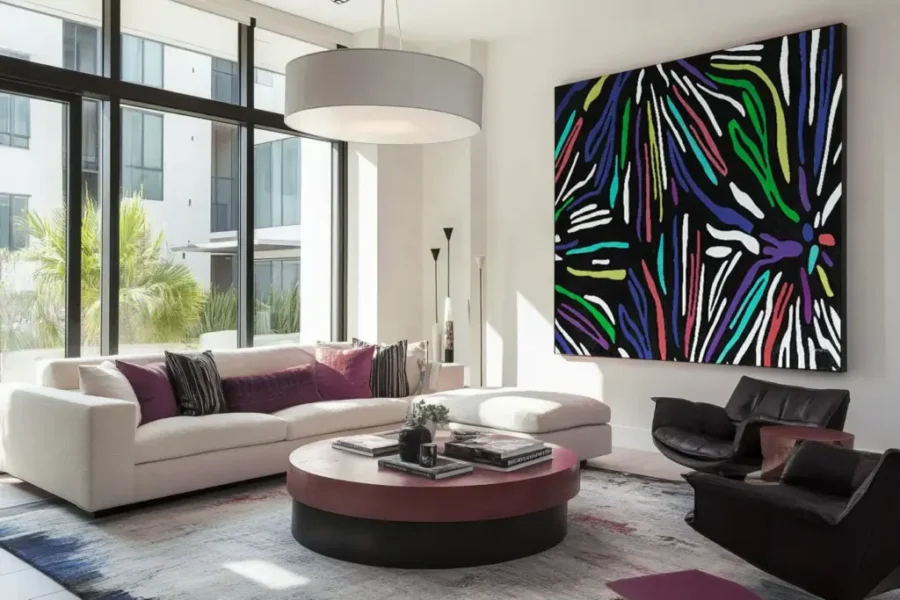
Abstract art in celebrity home renovations has moved from a niche collector’s choice to one of the most defining aesthetics in luxury interior design. Over the past decade, A-list names have transformed their private residences into gallery-worthy spaces, placing abstract works at the very heart of their design vision.
The movement is being driven by a handful of high-profile tastemakers. Kim Kardashian and Kanye West set the tone with their now-iconic Calabasas compound — a stripped-back, monochromatic environment where oversized abstract canvases replaced conventional decoration. Kylie Jenner followed suit, using bold gestural pieces as room-defining focal points. These are not passive decorating decisions; they are deliberate cultural statements.
Much of the credit belongs to the designers working behind the scenes. Axel Vervoordt, the Belgian designer responsible for shaping the Kardashian-West aesthetic, has long championed abstract and wabi-sabi-influenced art in residential settings. His influence has helped shift abstract works from gallery walls to living rooms across the world, democratising an art form once reserved for white-cube spaces.
Why Abstract Wall Art Is the Ultimate Statement Piece in Luxury Interiors
Abstract wall art dominates luxury interiors because it communicates sophistication without being prescriptive — it invites interpretation rather than dictating meaning. In large, open-plan spaces typical of high-end renovations, an oversized abstract canvas anchors the room visually and creates an immediate focal point that no other decor element can replicate.
One of abstract art’s greatest strengths is its versatility. It sits equally well within minimalist environments — where a single monochromatic canvas can define an entire room — and within maximalist schemes, where layered textures and colours find coherence through a bold abstract centrepiece. Unlike figurative or representational work, abstract art does not compete with surrounding furnishings; it elevates them.
- Living rooms: Large-scale works create drama and depth in open-plan layouts.
- Bedrooms: Softer, colour-field abstracts promote calm and visual warmth.
- Hallways: Narrow vertical pieces draw the eye and extend perceived space.
- Home offices: Geometric abstracts signal focus, creativity, and ambition.
Beyond aesthetics, abstract art functions as a form of cultural capital. In celebrity circles and among design-conscious homeowners alike, the art on your walls signals taste, worldliness, and an engagement with contemporary culture that no furniture purchase can replicate.
Inside the Most Iconic Celebrity Homes Featuring Abstract Art
The Kardashian-West Calabasas home remains the most referenced example of abstract art in a residential setting. Documented extensively in Architectural Digest, the property features a near-total absence of colour — raw concrete, bleached oak, and cream upholstery — punctuated by large abstract canvases that provide the only visual tension in the space. The effect is monastic yet undeniably luxurious.
Kylie Jenner’s approach is more expressive. Her interiors blend plush, tactile furnishings with bold abstract pieces that introduce colour and movement. Rather than treating art as background, she uses it as a conversation starter — a philosophy increasingly adopted by interior designers working with high-net-worth clients.
Beyond the Jenner-Kardashian universe, LeBron James has spoken publicly about his passion for contemporary art collecting, with abstract works featuring prominently in his properties. Beyoncé and Jay-Z are known to own significant abstract pieces, with their interiors reflecting a deep engagement with Black American abstract artists, adding layers of cultural meaning to their design choices.
These homes have collectively done something remarkable: they have made abstract art aspirational to mainstream audiences. When Architectural Digest features a celebrity home, the abstract works on the walls generate as much search interest as the architecture itself.
How to Choose the Right Abstract Wall Art for Your Home Renovation
Selecting abstract wall art for a renovation project requires the same strategic thinking celebrities and their designers apply — scale, colour, and context are everything.
Scale and proportion are the most common mistakes homeowners make. A piece that looks striking in a gallery can disappear on a large domestic wall. As a general rule, art should occupy between 57% and 75% of the available wall width to feel intentional rather than incidental. In double-height spaces, stacking or grouping pieces vertically maintains visual weight.
When it comes to colour, you have two equally valid approaches:
- Complementary: Choose abstract art that echoes tones already present in your furnishings for a cohesive, layered look.
- Contrasting: Use abstract art to introduce a colour that does not exist elsewhere in the room, creating tension and visual interest.
Understanding the different styles within abstract art also helps narrow the choice. Gestural abstraction — expressive, painterly marks — works well in warm, lived-in spaces. Geometric abstraction suits contemporary and Scandi-influenced interiors. Colour field painting, with its large blocks of flat colour, is ideal for minimalist environments where the art needs to do significant heavy lifting.
For those looking to explore a curated range of options, bold abstract wall art collections offer a strong starting point, with pieces designed to translate the gallery aesthetic into real domestic settings.
Bringing the Celebrity Abstract Art Trend Into Your Own Home
Replicating the celebrity abstract art aesthetic does not require a designer’s budget — it requires a designer’s eye. The principles that govern a Vervoordt-styled interior are the same ones that apply to a thoughtfully renovated terraced house.
Start with one statement piece rather than filling every wall. Celebrity interiors gain their power from restraint — a single oversized abstract canvas in a living room creates more impact than six smaller prints scattered around the same space. Commit to the centrepiece first, then build the room around it.
If you prefer a gallery wall approach, maintain coherence through a consistent colour palette or framing style. Mixing abstract works of different sizes works well when they share tonal harmony — all warm earth tones, for example, or a strictly monochromatic scheme.
Framing and hanging matter more than most homeowners realise. Unframed canvas works suit contemporary and industrial aesthetics. Thin metal or natural wood frames add definition without formality. Hang art so the visual centre sits at eye level — approximately 145–150cm from the floor — unless you are deliberately playing with scale in a high-ceilinged room.
Budget need not be a barrier. High-quality canvas reproductions and art prints have improved dramatically in recent years, with many pieces indistinguishable from originals at normal viewing distances. The investment is in curation, not necessarily in price.
The Future of Abstract Art in Home Design: Is This Trend Here to Stay?
Abstract art is not a trend in the conventional sense — it is a design philosophy with roots stretching back over a century, and its presence in residential interiors shows no sign of diminishing. Interior designers consistently cite abstract art as one of the most enduring choices a homeowner can make, precisely because it does not date in the way that pattern-led or figurative work can.
Social media has accelerated rather than created this appetite. Instagram and Pinterest have made abstract interiors globally visible, exposing millions of users to aesthetics previously confined to design publications. The result is a genuinely mass-market demand for abstract wall art that did not exist fifteen years ago.
The market has responded accordingly. The accessible abstract art sector — quality prints, canvas works, and limited editions at non-gallery prices — is growing rapidly, putting the celebrity aesthetic within reach of everyday homeowners for the first time. As AI-assisted design tools make it easier to visualise art in a specific space before purchasing, the barrier to confident buying is falling further.
Looking ahead, expect abstract art to evolve alongside broader interior trends — more textural, more tactile, and increasingly connected to sustainability narratives as collectors and homeowners seek works with provenance and purpose. But its place at the centre of considered home design is, by any measure, secure.
FAQ: Abstract Art in Celebrity Home Renovations
Which celebrities are most known for using abstract art in their home renovations?
Kim Kardashian, Kanye West, and Kylie Jenner are among the most prominent, frequently working with world-class designers to source museum-quality abstract pieces. LeBron James and Beyoncé are also notable collectors whose homes feature significant abstract works.
What types of abstract wall art work best in modern home renovations?
Large-scale canvas works, gestural paintings, and colour field pieces tend to deliver the greatest visual impact in contemporary spaces. Geometric abstracts suit minimalist and Scandi-influenced interiors, while expressive, painterly works add warmth to more eclectic schemes.
How can I incorporate abstract wall art into my home on a budget?
High-quality canvas prints and art reproductions now offer the luxury aesthetic at accessible price points. Focus on one strong statement piece rather than multiple smaller works, and invest in proper framing and hanging to maximise visual impact.
Do I need a large space to display abstract wall art effectively?
No. Smaller abstract pieces work beautifully in hallways, bathrooms, and bedrooms. The key is matching the scale of the work to the wall — a well-proportioned piece in a compact space is always more effective than an oversized work that overwhelms the room.
Is abstract art a sound long-term choice for home decor?
Abstract art has consistently appeared in top interior design publications for decades and remains one of the most timeless choices a homeowner can make. Unlike trend-driven decorative styles, abstract work evolves with the space around it rather than dating alongside it.
