
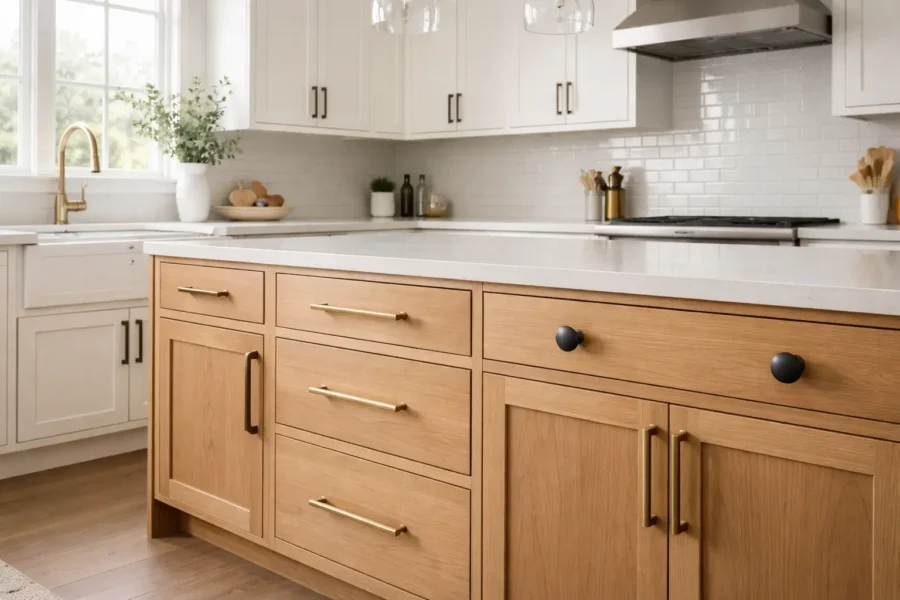
Cabinet hardware is no longer an afterthought – it’s a must-have system for your cabinets. Today cabinet hardware does more than just function as a handle or pull. It provides the perfect finishing touch, elevating the look and feel of the cabinets in a way that reflects your personal style.
Soft-close hinges are the floor, not the ceiling
It’s a warning sign if the cabinet maker is trying to sell soft-close hinges as a luxury add-on. Nowadays, this is standard hardware. Many reputable brands such as Blum and Hettich have implemented soft-close features as a standard feature for most high-quality custom shops. They should automatically be added to your estimate.
What you need to know: find out the brand of the hinge and obtain the model number. Both Blum and Hettich reveal load capacity and cycle numbers, so you can rest assured that you are receiving a real item rather than a generic duplicate that says “soft close” on the package.
Full-extension undermount slides carry the weight
Drawer slides are one of those things that just aren’t that important until they fail and you’re left with a drawer full of pots sagging out on its rails. Full extension undermount drawer slides provide complete access to the drawer box and, since there’s no hardware visible when the drawer is open, these have increasingly become the go-to option for anything more substantial than a utensil tray.
What to ask for: Full extension slides rated for at least 100-pound loads on any drawer that you’ll pull-out and load with cookware, small appliances, or trash bins. Cheaper partial-extension slides will do the job but you’ll always be reaching into the back of the drawer.
Handleless cabinetry needs precision, not just style
European handleless kitchens are another design reference point we’ve been living with for a few years. This sleek, modern look depends on either push-to-open latches or milled finger pulls routed directly into the door, both eliminating the handle and requiring exact door machining stock cabinet boxes can’t deliver.
Milled pulls especially need to be routed with pretty tight tolerances or the door edge looks sloppy up close. This is a fabrication detail, not a hardware store purchase.
What to ask for: a push-to-open latch with an integrated dampener so the door doesn’t bounce back open when you tap it closed. If you’re going with milled pulls, ask to see a sample door before the full run gets cut.
This stuff happens at the point of fabrication, not after you’ve brought a box home. And this, really, is the kind of work where custom fabrication is going to earn its keep. When you go with a custom cabinetry company like Skytop Cabinets, the fabricator is the one responsible for those routed finger pulls, the pre-drilled hinge locations, and the integrated wiring channels that make these hardware details possible. None of that happens with a stock box pulled off a warehouse shelf.
Integrated lighting is now a hardware category
In the past, under-cabinet lighting was installed after the cabinets were in place. This often necessitated a plug-in strip light, and a telltale cord dangled conspicuously behind the toe kick. Nowadays, LED strip lights are typically hardwired directly through the cabinetry. And switches are sometimes built right into the drawer, hidden neatly out of sight. This goes for toe kick and interior-cabinet strip lighting too. All require channels to be built into the cabinetry while it’s being constructed, not clumsily drilled in after the fact.
Mixing metal finishes is a deliberate move, not a mistake
Brass pulls on the island next to matte black hardware everywhere else used to read as inconsistent. Now it reads as intentional, provided the ratio is right. The safe rule most designers work from is roughly 90% primary finish and 10% accent, concentrated in one area rather than scattered randomly across the kitchen.
The National Kitchen & Bath Association’s 2024 Design Trends Report lists mixed metal finishes among the top directions in kitchen design this year, so this isn’t a fringe experiment. It’s a widely endorsed approach when it’s planned rather than improvised.
What to ask for: pick one accent piece, usually the island, and build the ratio around it before ordering hardware for the rest of the kitchen.
Knurled texture and linear pulls anchor the hardware plan
Textured knurled knobs can add a tactile design to simple door handles. On the other hand, long linear bar pulls can help maintain a neat, clean look in a shaker-style kitchen. Knurled knobs provide a place to grip, while linear bar pulls fade quietly into the background, offering room to let your other design elements take center stage.
Smart hardware is this cycle’s real differentiator
RFID locks installed on home office cabinets, motion-activated drawer lighting, and charging strips built directly into drawer dividing walls. These are the features that transform a truly custom kitchen from a very expensive stock option. None of this operates in a seamless manner if it’s not part of the planning well in advance, as installing power and connectivity to cabinet boxes after construction is a total hassle.
What you need to demand: a smart hardware check-list before the design is finalized and the order is placed.
Hardware isn’t decoration anymore. It’s mechanical, it’s electrical, and increasingly it’s the thing that separates a kitchen that just looks good from one that actually works the way you need it to every single day.
