
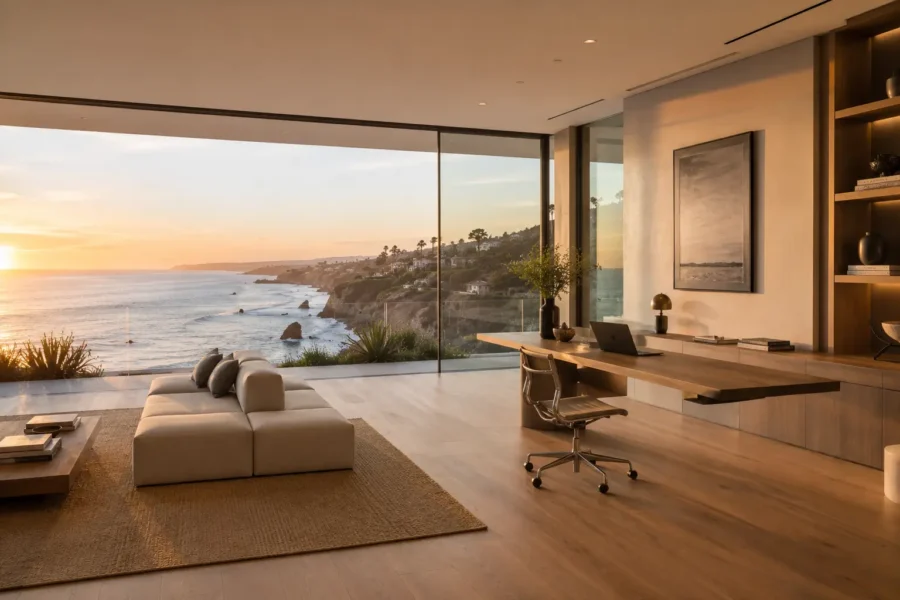
I have toured, studied, and broken down hundreds of celebrity homes over the years, and there is one feature that shows up again and again at the top of the market. It is not the wine cellar. It is not the home gym or the infinity pool. It is the glass. Specifically, the floor-to-ceiling walls of glass that the best homes order straight from a specialist panoramic windows manufacturer to pull the entire view inside.
Once you start noticing it, you cannot stop. The Malibu beach houses, the Hollywood Hills hideaways, the Austin compounds that keep popping up in my research. They all lean on the same trick. Big, uninterrupted walls of glass that make the line between inside and outside almost disappear. So why are the people who can afford anything choosing this one thing so consistently? Having spent a long time looking at how these homes are actually built, I have a few answers.
The view is the real luxury
Here is the thing most people miss. When someone spends millions on a home, a large chunk of that money is not paying for the building. It is paying for where the building sits. The cliff over the Pacific. The canyon. The skyline. The lake. That location is the most expensive thing they own, and a panoramic window is how you actually get to enjoy it.
A small punched window treats a view like a painting on the wall. You glance at it and move on. A full panoramic wall treats the view like part of the room. The ocean becomes your ceiling line. The city lights become your evening wallpaper. For someone who paid a premium for the setting, this is the only way to get their money’s worth out of it. The window is not the luxury. The window is what unlocks the luxury they already bought.
Light does something money cannot fake
I spend a lot of time analyzing how rooms feel, not just how they look in photos, and natural light is the single biggest factor. You can fill a room with expensive furniture and the best finishes available, and it will still feel flat if the light is wrong. Panoramic glass solves this in a way nothing else can.
When an entire wall is glass, light pours in from every angle and changes throughout the day. Morning light hits differently than late afternoon light, and the room shifts with it. This is why celebrity homes shot for magazines always look so alive. It is not just the styling. It is the volume of daylight moving through the space. No amount of clever lighting design replicates what a wall of glass does for free, every single day.
There is also a psychological piece here. Bright, open, light-filled spaces simply feel better to be in. For people whose lives are high pressure and constantly watched, a home that feels calm and expansive is worth a great deal. The glass is doing emotional work, not just visual work.
It signals a very specific kind of wealth
Not all luxury looks the same. There is loud luxury, which is gold taps and marble everywhere, and there is quiet luxury, which is restraint, space, and light. Over the last several years the top of the market has moved hard toward the second kind, and panoramic windows are central to that look.
A wall of seamless glass says something specific. It says the owner values openness, design, and the setting itself over showy decoration. It is the architectural equivalent of a plain, perfectly cut piece of clothing that costs more than the flashy version. People in the know recognize it instantly. That is exactly why it has become such a status marker among celebrities who want to signal taste rather than just money.
The engineering is harder than it looks
This is the part that gets overlooked, and it is the part I find most interesting as someone who cares about how homes are actually constructed. Putting up a giant wall of glass is not as simple as ordering a bigger window. There is real complexity behind it, and that complexity is part of why it reads as premium.
A few things have to be solved at once:
- Structure. Glass does not hold up a roof, so the building has to carry its weight in other ways while still looking open and unsupported. That takes proper engineering.
- Climate. A massive sheet of glass can turn a room into a greenhouse or leak heat in winter. Modern panoramic glass uses advanced coatings and multiple layers to control temperature, which is why the technology behind it matters so much.
This is also where the choice of supplier becomes a big deal. The difference between a wall of glass that performs beautifully and one that fogs up, leaks, or bakes the room comes down to who made and installed it. Working with an experienced manufacturer is what separates the homes that look incredible and feel comfortable from the ones that only photograph well. The glass has to be engineered for the specific climate, orientation, and structure of the home, and that is not something you get off a shelf.
What the rest of us can take from it
You do not need a celebrity budget to borrow the thinking here. The lesson is simple. If your home has any kind of view worth seeing, even a nice garden, the window is what decides whether you actually experience it or just walk past it. Scaling up your glazing toward the best feature of your property is one of the highest impact changes you can make.
The celebrities are not obsessed with panoramic windows because of a trend. They are obsessed because the feature solves several problems at once. It maximizes an expensive view, floods the home with light, signals a refined kind of taste, and shows off serious engineering. Few other design choices do that much work in one move.
So the next time you scroll through a jaw-dropping celebrity home and feel that pull of envy, look closer. Most of the time, the thing you are really responding to is the glass
