
The Hidden Heat of High-End Automation Systems
Modern luxury estates rely heavily on enterprise-grade automation systems to orchestrate everything from lighting and climate to robust security and high-fidelity entertainment. Industry-leading platforms like Crestron or Control4 operate continuously, functioning as the central nervous system of the property.
These intricate networks require massive processing power, generating significant thermal output. When these high-heat components are concealed within Bespoke Cabinetry, passive ventilation is entirely insufficient.
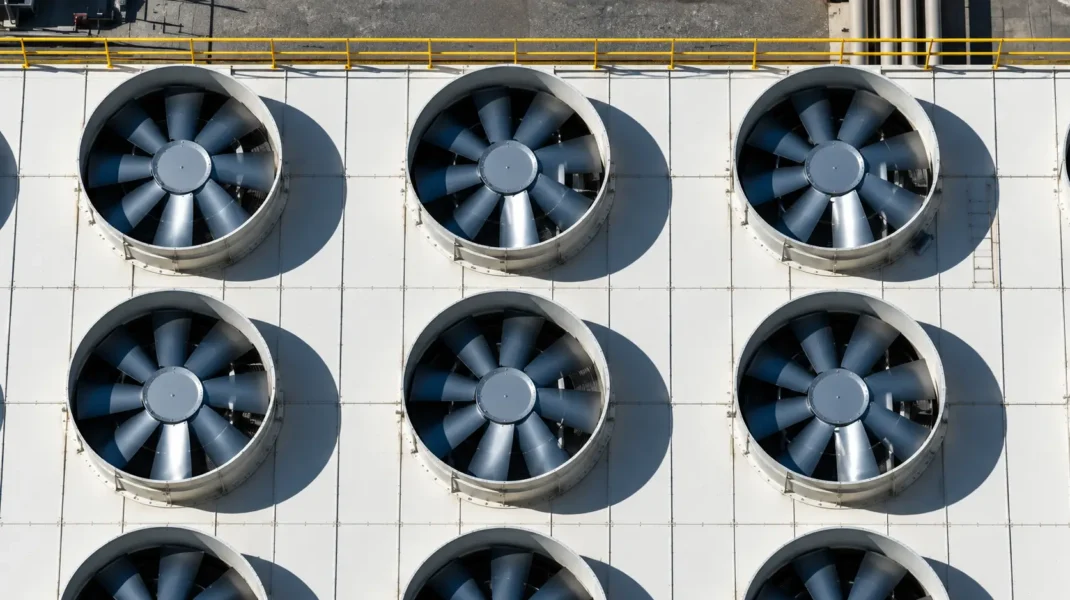
To prevent Thermal Throttling and hardware degradation in tight residential enclosures, AV Integrators and architects increasingly specify professional ACDCFAN AC axial fans designed for continuous operation. Unlike standard consumer electronics fans, these robust units ensure stable, high-volume airflow that protects the home’s multi-million-dollar technological infrastructure.
Convection vs. Active Airflow in Custom Cabinetry
Why Passive Vents Fail
Traditional millwork design often relies on passive convection, utilizing small slits or grilles cut into the wood to allow heat to escape. This approach relies on natural physics where warm air rises, but it lacks the velocity to clear densely packed equipment racks.
High-performance amplifiers and matrix switchers rapidly overwhelm passive systems, creating trapped pockets of stagnant, superheated air. Over time, this ambient heat bakes internal circuitry, severely degrading the performance and lifespan of the equipment.
- Inadequate Volume: Passive slots cannot exchange air fast enough to match the thermal output of modern AV gear.
- Dead Zones: Heat becomes trapped in the upper corners of unvented custom shelves.
- Aesthetic Compromise: Adding more passive grilles disrupts the visual purity of luxury woodwork.
Designing Push-Pull Airflow
The definitive solution for custom architectural enclosures is engineering a Push-Pull Configuration. This active airflow strategy utilizes mechanical fans to create a deliberate and continuous cycle of thermal exchange.
Intake fans are positioned at the base of the cabinetry to draw in cool, ambient room air. Simultaneously, exhaust fans are mounted at the highest possible point to forcefully expel the rising hot air.
- Directional Flow: Forces cool air directly over the heat sinks of the hottest electrical components.
- Controlled Velocity: Maintains a consistent, safe ambient temperature within the entire cabinet.
- Discrete Placement: Fans can be hidden behind toe-kicks and false ceiling gaps, preserving the interior design.
Balancing Airflow with Acoustic Design
In a high-end residential environment, mechanical noise from cooling equipment is entirely unacceptable. The luxury experience demands both seamless home automation and absolute acoustic tranquility.
Specifying industrial-grade fans does not mean introducing industrial-level noise into a quiet screening room or master suite. Engineers solve this by utilizing advanced motor designs and precision controls to move large volumes of air silently.
Fans equipped with high-quality dual ball bearings operate smoothly, eliminating the rattling and vibration common in cheaper sleeve-bearing alternatives. Furthermore, integrating Pulse-Width Modulation (PWM) allows the smart home system to dynamically adjust fan speeds based on real-time temperature data.
- Whisper-Quiet Operation: Fans run at minimum RPMs during low-demand periods to maintain silence.
- Vibration Isolation: Rubber mounting gaskets prevent resonant noise transfer into the wood cabinetry.
- Dynamic Response: Airflow automatically increases only when AV equipment reaches heavy processing loads.
Safety Standards and Thermal Protection
A poorly ventilated tech closet isn’t just an inconvenience; it is a critical failure point for the home’s entire digital ecosystem. When designing dedicated server rooms or enclosed AV racks in luxury residences, architects must strictly account for heat dissipation to prevent system crashes.
Understanding the fundamentals of thermal management is essential for ensuring that high-performance processors, amplifiers, and matrix switchers operate within their safe temperature thresholds, ultimately preserving both the equipment’s lifespan and the property’s safety.
Sustained overheating inevitably leads to melted wiring, blown capacitors, and in extreme cases, localized fire hazards. Proper mechanical ventilation eliminates these risks while satisfying rigorous residential electrical safety codes.
Key Takeaways
| Area | Key Takeaway | Impact/Data |
| Ventilation | Replace passive slots with active push-pull cooling | Eliminates thermal dead zones |
| Hardware | Specify professional AC axial fans | Prevents thermal throttling and degradation |
| Acoustics | Integrate PWM control and dual ball bearings | Ensures whisper-quiet operation, zero vibration |
| Safety | Maintain safe ambient temperatures in AV racks | Eliminates fire hazards and melted wiring |
Conclusion: Marrying Aesthetics with Performance
True luxury design does not compromise on unseen mechanical engineering. The flawless execution of a high-end interior requires the underlying technology to function flawlessly without intruding on the visual space.
By proactively integrating active thermal management into custom millwork, architects and AV integrators protect the homeowner’s investment. Superior airflow ensures that multi-million-dollar smart home systems remain invisible, silent, and exceptionally reliable for years to come.
