
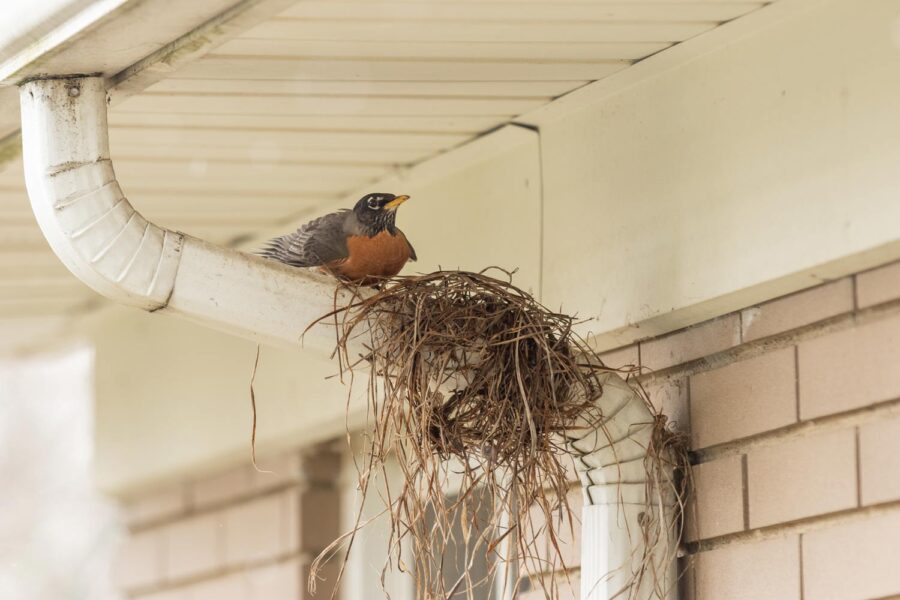
Many homeowners consider pest birds a nuisance but the truth is a feral pigeon colony that has made a nest on your roof is slowly and surely taking apart the exterior of your home from the outside. Unfortunately, the repair bill often shows up long before most homeowners are even aware there is an issue.
What bird droppings actually do to your roof
Bird droppings are not just unpleasant and dirty, they also have a high amount of uric acid which acts like a corrosive on almost all external building materials. From asphalt shingles to clay tiles and paint, uric acid seeps into the material and destroys the protective coating that prevents water from entering.
The worst damage happens on an asphalt roof. Many warranties for shingles clearly state that exposure to certain chemicals and waste products voids the warranty. So if you find out you have water entering your roof after years of pigeon damage, you may end up having your warranty claim denied and be forced to pay the full cost of re-roofing, something you thought you were protected from.
Feral pigeons are the main culprits in this case. One bird produces a lot of waste every day and even a dozen birds produce enough waste to saturate one part of the roof.
Why plastic owls don’t work
DIY deterrents are attractive solutions. A plastic owl or some reflective tape only costs a couple of dollars, and doesn’t hurt as a first try. The issue is feral pigeons are smart, adaptable birds. They can easily see that plastic owls and tape aren’t moving, living things and will not be perturbed by them. This adjustment can take as little as 2 to 3 days. Acoustic deterrents only cause slight disruption and disorientation to the pigeons for a couple weeks until they become used to the noise.
Visual and sound deterrents are a waste of time and money because they are an extremely temporary fix to a permanent problem. They also encourage birds to get used to deterrence measures rather than flee from them. If it costs you time, effort, and money, and it has no proper effect on pigeon behavior, why do it?
It may be because you don’t realize that pigeons are going to stick to whatever food source they’ve settled on if at all humanly possible. You may not realize that while 2 pigeons may not constitute a monumental mess and health hazard that requires netting, spikes, and waste removal, they will go forth and multiply until 2 pigeons turns into 20 or more pigeons. Or, you don’t know that concerns about dangerous pathogens and structural damage should outweigh the cost of doing it right.
The long-term solutions that actually work are physical exclusion methods. Bird spikes deter pigeons from landing on ledges and rooflines, and exclusion netting keeps them out of balconies, cavities, and vents. But safe cleanup of hazardous droppings and proper installation of these barriers means hiring a pigeon control and removal service rather than attempting a dangerous rooftop job yourself. A biohazard situation is not the time or place for DIY or handyman enterprises to get in over their heads.
The gutter problem no one mentions
Pigeons and other pest birds do not just perch on roofs, they actually construct their nests there. Eaves, soffits, and gaps along a roofline are attractive nesting sites as they provide protection from the wind and predators. The nesting materials brought into gutters and downspouts by the birds – twigs, straw, feathers, and other debris – eventually block the system.
Once a gutter is partially obstructed, it is unable to cope with a heavy rain and water will find alternative routes. The overflow of rainwater will flow behind the fascia board and seep into the attic or run down to the foundation. Fascia rot is one of the most frequent and silent damages faced by homeowners. Bird carcasses and accumulated waste in gutters weigh more than the system was designed to support. The increased weight can cause the gutters to pull mounting hardware loose and even detach sections of gutter.
Solar panels and the fire hazard most installers don’t warn you about
If you have solar panels on your home, the space beneath them provides the perfect sheltered environment for pigeons to roost and nest. The panels are elevated several inches off the surface of the roof, creating a warm, enclosed space that is virtually predator-proof.
The nesting materials that birds place in this space are highly flammable. Together with the wiring that typically runs directly underneath the panels – which birds like to peck at and can damage, potentially causing an electrical fire – the danger is real and well-documented. The electrical risks alone should give you pause for thought.
The accumulated droppings that build up on the surface of the solar panels block the sunlight and decrease the amount of energy your system harvests. In fact, research from the National Renewable Energy Laboratory (NREL) in the US has shown that the soiling of solar panels – which is vastly accelerated by bird droppings – can reduce the amount of electricity produced by as much as 25%. That’s a quarter of your investment down the drain if you allow birds to make themselves at home under your panels.
The health dimension: beyond aesthetics
Bird droppings that have accumulated aren’t harmless, they don’t just pile up before washing away with the rain. As the droppings age they become lighter, dryer, and much more likely to break apart. This process of drying and crumbling continues until the feces has become a dry, white powder.
When bird droppings become dry that’s when they start to pose a serious health risk. Imagine the dust on your furniture or coming from your vents isn’t dust but minute particles of dried bird poop. This fecal dust is blown from the nest by the gentlest of breezes, and can carry histoplasmosis, cryptococcosis, and other diseases.
Your home’s exterior is the first and most expensive line of defense against the elements. Pest birds don’t respect that. Getting ahead of an infestation before it compounds is the only approach that makes financial sense.