
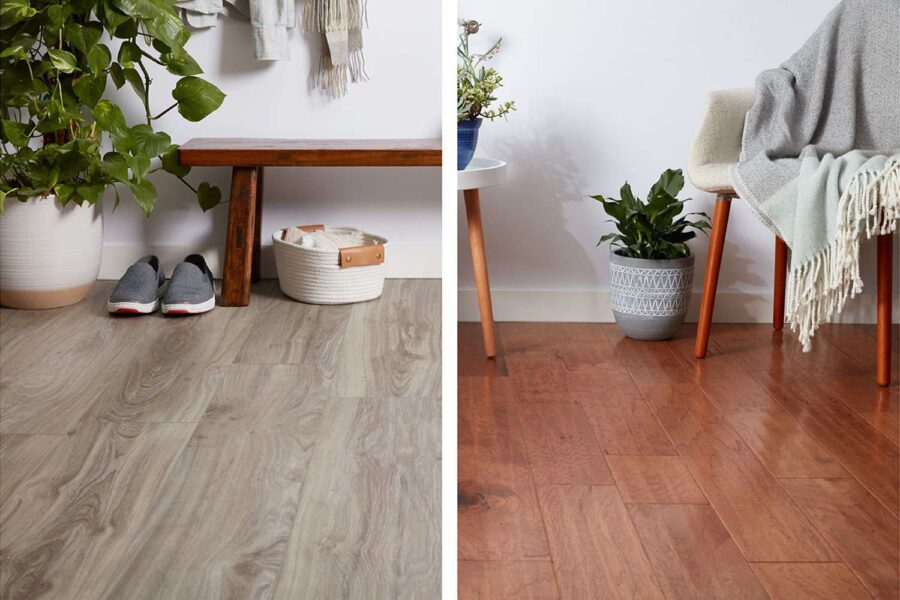
Everyone buys a hardwood color or LVP style first and then they work backward. That’s the wrong way to think about it. Color is the only decision you can reverse a few years later with a refinish or paint. The rest – what’s underneath the color – defines the floor’s life or lack thereof for the next 20 or 30 years. This article breaks down what to consider when shopping for wood or vinyl plank flooring so you don’t regret the decision a decade from now.
Seven decisions define the satisfaction you feel with your hardwood or LVP floor long-term.
Wear Layer Thickness Define the floor’s longevity based on the home’s needs
The wear layer of luxury vinyl planks is measured in mils and is responsible for the flooring material’s resilience; 6, 12, 20, and 28 mil options are common in the showrooms. It may appear that the 6 mil option is too thin, but in reality, it is right at home in the bedroom where it only accommodates the occasional guest. The 6 mil option will not last in a high-traffic room or anywhere pets are permitted. Twelve mil is the minimum thickness needed in the kitchen to handle the occasional spill and mess. Twenty or more mils is desirable in the home of active families or the home where large items of furniture are dragged around the floor on a regular basis.
It may come as a surprise that the 12 mil planks are priced near their 28 mil counterparts. Many homeowners make the mistake of selecting the lowest-priced LVP in the showroom and are shocked to find that the floor looks worse after five years because it lacks the resilience of a board with a thicker wear layer.
The Janka Scale Has little bearing on the value of the finished floor
The Janka Scale ranks the density of species based on the pounds of pressure required to embed a steel ball into the wood. Brazilian Walnut is one of the hardest species on the scale, while Douglas Fir ranks soft. Salespeople love the Janka Scale because it gives buyers an expectation of performance based on numbers, and numbers seem to help buyers feel confident about the purchase.
Hardness is a characteristic that has little bearing on the value of the finished floor. Janka ratings apply to the rough-cut wood, not the finished flooring material. A finished board of any species will have far less density than its raw counterpart. The finish on a hardwood board matters far more than its hardness, and in the case of luxury vinyl planks, the aluminum oxide finish on the plank’s surface determines the resistance to scuffs and scratches.
The stability of the hardwood and the skill of the installation are more critical to the end value of the finished floor than the Janka rating. A beautiful species installed over a poorly conditioned subfloor will be far less valuable than the cost of materials suggests; a hardwood floor that does not react to changes in moisture will maintain its good looks for far longer than an equally attractive species that cups after every rainstorm.
Acclimation Is a detail hardwood requires but LVP avoids
Solid and engineered hardwood needs to stabilize, or acclimate, to its environment before it is installed. Floating floors of pressed wood or vinyl plank can be installed right out of the box.
The standard acclimation window for wood is three to seven days, and the project wood must be stored in the room where it will eventually be installed. Failure to allow the wood to acclimate results in floors that gap in the winter or crown in the summer. These are the most common callbacks in the flooring industry. It is also common to discover that the cause of the problem was failure to acclimate the wood or failure to test the moisture content of the subfloor before the installation began.
Vinyl plank flooring does not require acclimation, and that is a big benefit for the do-it-yourselfer. However, it is a small advantage that comes with some caveats. The polymer core is stable in any environment, so the planks can go down the same day they arrive at the jobsite.
When shopping for hardwood, keep in mind that acclimation affects the warranty. Most manufacturers have separate structural warranties and finish warranties. Installation of the wood without a proper acclimation period usually eliminates the structural warranty. Anyone who is shopping for a higher-end LVP against an entry-level engineered hardwood should ask to see samples and warranty language on both the wear layer and the installation method before buying the first box. There are plenty of details to consider when a specialist walks through the contract with you; a company like Luminous Flooring can explain the fine print.
Refinishing Capacity Is a consideration for repeat visits
Most homeowners buy hardwood without thinking about the long-term costs of refinishing. Solid hardwood has a longer refinishing capacity than engineered hardwood, based on the thickness of the planks and the amount of wood that is removed with each sanding. Five turns, on average, is the expected lifetime capacity for solid hardwood, while engineered hardwood has a capacity of one to two turns, depending on the thickness of the top layer and the center core. There is no refinishing capacity for luxury vinyl planks.
The costs of a total refinishing for wood start at $4,000 and increase based on the size of the job and the complexity of the finish. Over the 30-year lifespan of a hardwood floor, a homeowner who buys an entry-level solid hardwood at $6 per square foot may expect to spend $10,000 to turn the floor over twice. The owner of the LVP at $4 per square foot will be replacing the planks in one high-traffic area of his home in year 15 and thinking of another turn in year 30.
Moisture Management Depends on the room, not the material
LVP is a better option than hardwood in nearly any space where standing water is a possibility. That includes bathrooms, laundry rooms, mudrooms, and basements, and it is one reason vinyl tiles and planks are installed in so many residential settings.
Water cannot penetrate vinyl, but that does not mean the material is waterproof. Gaps or spaces between the planks or tiles allow moisture to work its way to the underlying materials. Failure to use a moisture barrier between the LVP and the subfloor means that moisture has soaked the insulation or the padding and will remain there until it evaporates or until the floor is lifted. This can be far more expensive than anticipated if you have a concrete subfloor and the moisture has worked its way to the rebar. The best way to avoid moisture headaches with vinyl or hardwood is to invest in a calcium chloride moisture test on a concrete slab before you buy any materials.
Installation Method Impacts the sound and structure of the floor
Floating vinyl plank can be installed by the DIY owner with little trouble; it only takes a weekend to rough in a room. The downside is that it is a floating floor and, as such, will have a slight hollow sound and bounce when walked on. This is not a problem in well-insulated spaces, but it can be irritating in a large, open floor plan. Sound transfers more freely between floors in a floating install than it would in a nailed-down hardwood tongue-and-groove floor. This is rarely an issue in the basement, but it may be a deal-clincher in the purchase of the townhouse above.
Nailed-down hardwood has a stiffer look and sound than the floating vinyl plank, but it is far more expensive and requires a professional installation crew. The benefits far outweigh the costs if sound is an issue, and the ability not to hear every pin drop is far more valuable in some homes than the extra expense.
LVP can also be installed with a glue-down method. It is a middle ground between a floating install and a nailed-down hardwood install. The benefits include the sound and structure of a nailed-down hardwood, while the downsides include higher material costs and some limitations regarding when the new floor can be trafficked. Underlayment plays a big role in the sound characteristics of the floor; cork is a good option if sound is a concern and is also useful as a moisture barrier. Foam is a less expensive option but is not as effective. Some LVP products also have glued-on underlayment; it may make more sense to choose a vinyl product with a built-in sound barrier if the budget allows.
Lifecycle Costing Favors hardwood over vinyl, despite the higher initial investment
In nearly every aspect of material costs and installation, vinyl plank flooring wins out over hardwood. It is less expensive per square foot, faster to install, easier on the hands and back of the person who installs it, and totally devoid of the mess and headaches of sanding. It is simple to justify the purchase of an LVP when thinking in terms of a single flooring project.
Think in terms of 30 years and it is far more difficult to say the same thing about vinyl plank. Hardwood flooring has the potential to last 50, 75, even 100 years with regular maintenance and refinishing every 10 to 15 years. Luxury vinyl planks, even those with thick wear layers, only have a lifespan of 15 to 25 years before they need to be replaced. The longer the lifespan, the more valuable the initial investment of money and effort becomes. A single refinishing of a hardwood floor costs roughly the same as the initial purchase and installation. The owner of an LVP has already replaced the floor once during the same time and is looking at costs for the second refinishing.
There is also a resale value angle to be had with hardwood. The 2023 Remodeling Impact Report from the National Association of Realtors shows that refinishing existing hardwood can actually recoup all of the costs at resale; the value of a new hardwood installation recouped between 73 and 100 percent of costs depending on the finish. Few home improvement projects have that sort of ROI potential; hardwood refinishing is one of them. LVP does not have the same sort of benefit, but it still has value in the context of a home. It is a neutral addition to the value of a home and is preferred by buyers with pets, children, and basements.
Health and Environmental Impact Are worth consideration in the decision-making process
Finishes on hardwood and adhesives on flooring emit VOCs into the air of the home, and those fumes can linger for months or longer. For young children or people in the home with sensitivities, that means choosing low-VOC finishes and FSC-certified woods when applicable. Finishes made with oil and cured on-site have more VOCs than water-based finishes and should be avoided in favor of the latter when the time comes to recoat the floors.
LVP is a plastic composite, and the plasticizers used to keep it pliable can contain phthalates. The same concern applies to the adhesives used in glue-down installations, however. Phthalates are toxic to small children and pets, so it is vital to make sure that no harmful materials are used in any part of the installation. When considering a floor over radiant heat, look for FloorScore or GREENGUARD certification and make sure the floor has been approved for use over a heated subfloor. Not all LVP is suitable for the task, and doing so can void the warranty or reduce the lifespan of the floor.
The choice between LVP and hardwood is rarely simple. It is always a matter of what the home requires and what the owner expects the flooring to achieve. One certainty is that the color of the floor fades quickly in the face of other considerations. It is the only characteristic that can be changed relatively easily. The options affecting the future satisfaction of the homeowner are far more difficult to reverse and should not be overlooked at the showroom.
