
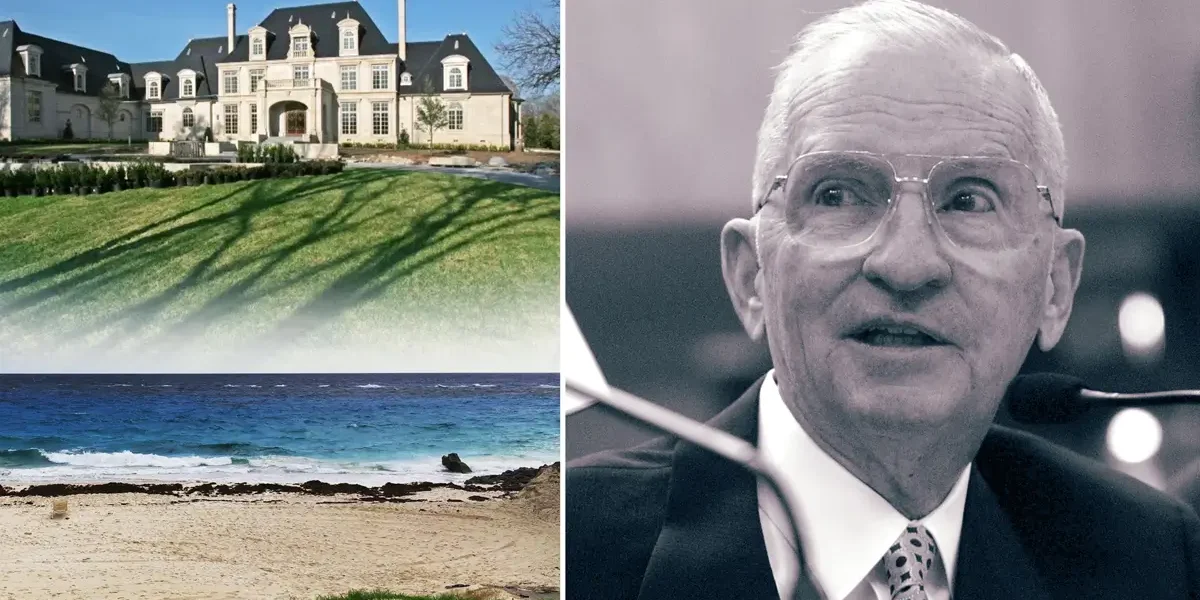
The Ross Perot estate is a private residential compound located on Strait Lane in Preston Hollow, Dallas, Texas, historically associated with H. Ross Perot, the American billionaire businessman, technology entrepreneur, and two-time U.S. presidential candidate. The property is defined by approximately 16 acres of land, an 8,200-plus-square-foot primary residence, and a large secondary structure exceeding 8,400 square feet. Within Dallas real estate, it is recognized as one of the most significant legacy estates in Preston Hollow due to land scale, location, and long-term ownership, placing it in the $60M-class tier of trophy properties by market context, not by a single public listing.
This article answers the core question directly: what is the Ross Perot estate, where is it located, how large is it, and why is it considered one of Preston Hollow’s most important properties. Every detail below ties specifically to this single property and its documented characteristics.
Overview: The Ross Perot Estate
The Ross Perot estate is a low-visibility, high-security residential compound situated in Preston Hollow, one of Dallas’s most exclusive residential enclaves. The property sits along Strait Lane, a corridor known for hosting the city’s largest and most valuable private estates.
Verified structural attributes include:
- Land area: approximately 16 acres
- Primary residence: approximately 8,200–8,264 square feet
- Secondary structure (outbuilding): approximately 8,446 square feet
- Ownership association: Ross Perot and family
- Use type: private residential homestead
Public appraisal records over time have placed the estate’s assessed value in the high eight-figure range, while its market-class positioning aligns with Dallas estates that trade or are referenced near $60 million due to land rarity and location.
Location Precision: Strait Lane, Preston Hollow, Dallas
The defining attribute of the Ross Perot estate is location combined with land scale.
Strait Lane is a controlled-access residential artery in Preston Hollow that functions as Dallas’s trophy-estate corridor. Properties along this stretch are characterized by:
- Deep setbacks
- Large acreage parcels
- Gated access
- Minimal street visibility
Within Preston Hollow, parcels exceeding 10 acres are exceptionally rare. A 16-acre tract inside Dallas city limits places the Ross Perot estate among the largest private residential holdings in the area.
This geographic positioning is the foundation of the estate’s long-term valuation strength.
Land Scale: The Core Asset
The 16-acre footprint is the most critical value driver of the Ross Perot estate.
In Preston Hollow, most high-end residences sit on 1 to 3 acres. Estates exceeding 5 acres are uncommon. At 16 acres, the Perot property functions as a self-contained residential domain, not a standard luxury lot.
This land scale enables:
- Complete visual isolation from public roads
- Long internal driveways
- Layered security perimeters
- Separation of residential, operational, and service zones
The land, not the structure, is the estate’s defining asset.
Primary Residence: Size, Purpose, and Positioning
The main house, measured at approximately 8,200–8,264 square feet, is notably restrained relative to the size of the land it occupies.
In the context of Preston Hollow:
- The residence is functional rather than exhibition-driven
- The structure is positioned to prioritize privacy over prominence
- The scale supports full-time residential use without excess vertical or horizontal sprawl
This configuration aligns with long-term owner occupancy rather than speculative development or resale optimization.
Secondary Structure: Operational Capacity
One of the estate’s most concrete and revealing features is its 8,446-square-foot outbuilding, which exceeds the size of many standalone luxury homes in Dallas.
While interior use details are not publicly itemized, the documented scale alone indicates the estate was designed with:
- Dedicated operational infrastructure
- Service and logistics capacity
- Functional separation from the primary residence
The presence of such a structure confirms the estate operates as a compound, not a single-building residence.
Security and Access Control
The Ross Perot estate is consistently described through verified reporting as intentionally inaccessible and visually obscured.
Documented features include:
- Large iron entry gates
- Extended internal driveways
- Dense perimeter landscaping
- Controlled access points
Security was a design parameter, not an add-on. This approach reflects Ross Perot’s public profile and long-standing need for controlled residential environments.
Ownership Context and Historical Significance
The estate’s identity is inseparable from H. Ross Perot’s realoss in American business and political history.
Ross Perot was:
- Founder of Electronic Data Systems (EDS)
- A multi-billionaire by the early 1980s
- An independent candidate in the 1992 and 1996 U.S. presidential elections
- A long-term Dallas resident with deep regional ties
The estate functioned as his primary homestead, reinforcing its role as a permanent family residence rather than a transient luxury holding.
Appraised Value vs. Market-Class Positioning
Public appraisal snapshots over time have placed the estate between:
- Low $20M range (earlier assessments)
- High $20M to near $30M range (more recent assessments)
These figures represent tax-based assessments, not open-market transaction values.
In Preston Hollow, estates with:
- Double-digit acreage
- Strait Lane frontage
- Legacy ownership
- Compound-level infrastructure
Are routinely discussed in the $60M-class category, even when not formally listed.
The Ross Perot estate fits this classification based on land scarcity and strategic positioning, not listing price speculation.
Why the Estate Is a Preston Hollow Landmark
The Ross Perot estate is considered a landmark property for three concrete reasons:
- Unmatched land scale within Dallas city limits
- Permanent association with a nationally significant figure
- Location on Preston Hollow’s most exclusive residential corridor
These attributes give the estate reference-point status in Dallas real estate discussions.
Long-Term Asset Stability
From a property-analysis perspective, the estate demonstrates exceptional durability:
- Land value dominates structure value
- Location scarcity increases over time
- Zoning and parcel consolidation make replication impossible
- Legacy estates face limited market competition
These factors explain why the Ross Perot estate maintains relevance decades after its original development.
Final Assessment
The Ross Perot estate is a large-scale residential compound in Preston Hollow, Dallas, defined by approximately 16 acres of land, an 8,200-plus-square-foot main residence, and an 8,400-plus-square-foot secondary structure. It is historically associated with H. Ross Perot, one of the most influential American businessmen of the late 20th century.
While public assessments place its taxable value below $60 million, its market-class standing, land rarity, and geographic position firmly place it among Dallas’s highest-tier legacy estates.
This property is not notable for spectacle. It is notable for control, permanence, and scale, which is precisely why it remains one of Preston Hollow’s defining residential landmarks.
