
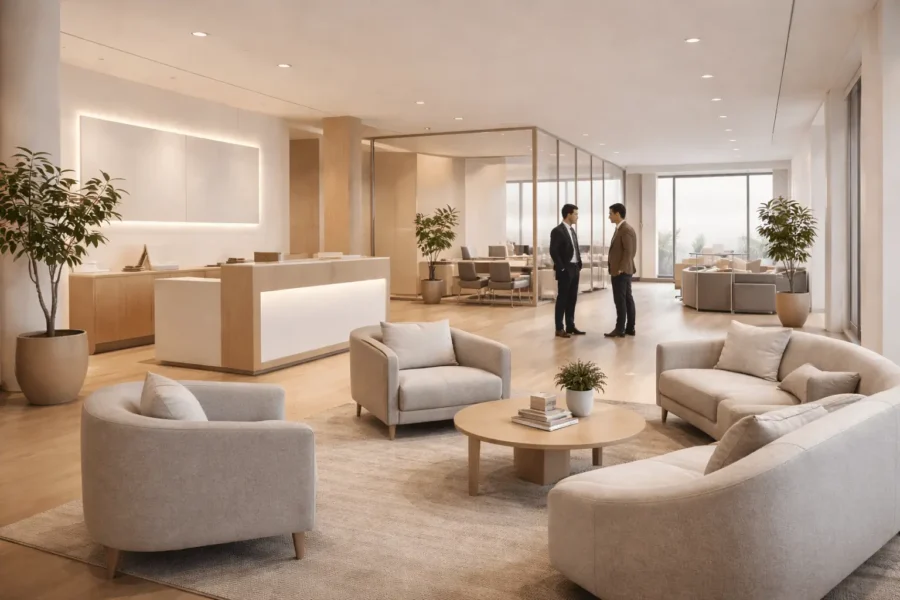
In the modern corporate and commercial landscape, physical space has transcended its traditional role as a mere operational backdrop. Forward-thinking enterprises, hospitality groups, and luxury brands no longer view square footage as a fixed overhead expense. Instead, premier real estate is increasingly recognized as a dynamic asset—a silent partner capable of driving customer acquisition, enhancing employee retention, and elevating brand equity.
Investing in high-end commercial spaces is fundamentally a calculated business decision. When executed with precision, commercial interior design yields measurable returns, transforming physical environments into strategic tools for long-term financial growth.
The Strategic Value of Commercial Interior Design Services
Every corporate headquarters, boutique hotel, and flagship retail space serves as a tangible manifestation of a brand’s DNA. The deployment of professional commercial interior design services is the mechanism through which an abstract corporate philosophy is translated into a three-dimensional experience.
| STRATEGIC SPACE OPTIMIZATION | ||
|---|---|---|
|
STAGE 01
Brand Alignment Values & Identity |
STAGE 02
Structural Layout Flow & Ergonomics |
STAGE 03
UX / ROI Profits |
When a business optimizes its physical environment, it directly influences human behavior. The strategic layout of a space dictates how a customer navigates a retail floor, how a guest feels upon entering a luxury lobby, and how productively a team collaborates within an office suite. This level of intentionality requires a deep alignment between architectural principles and behavioral psychology.
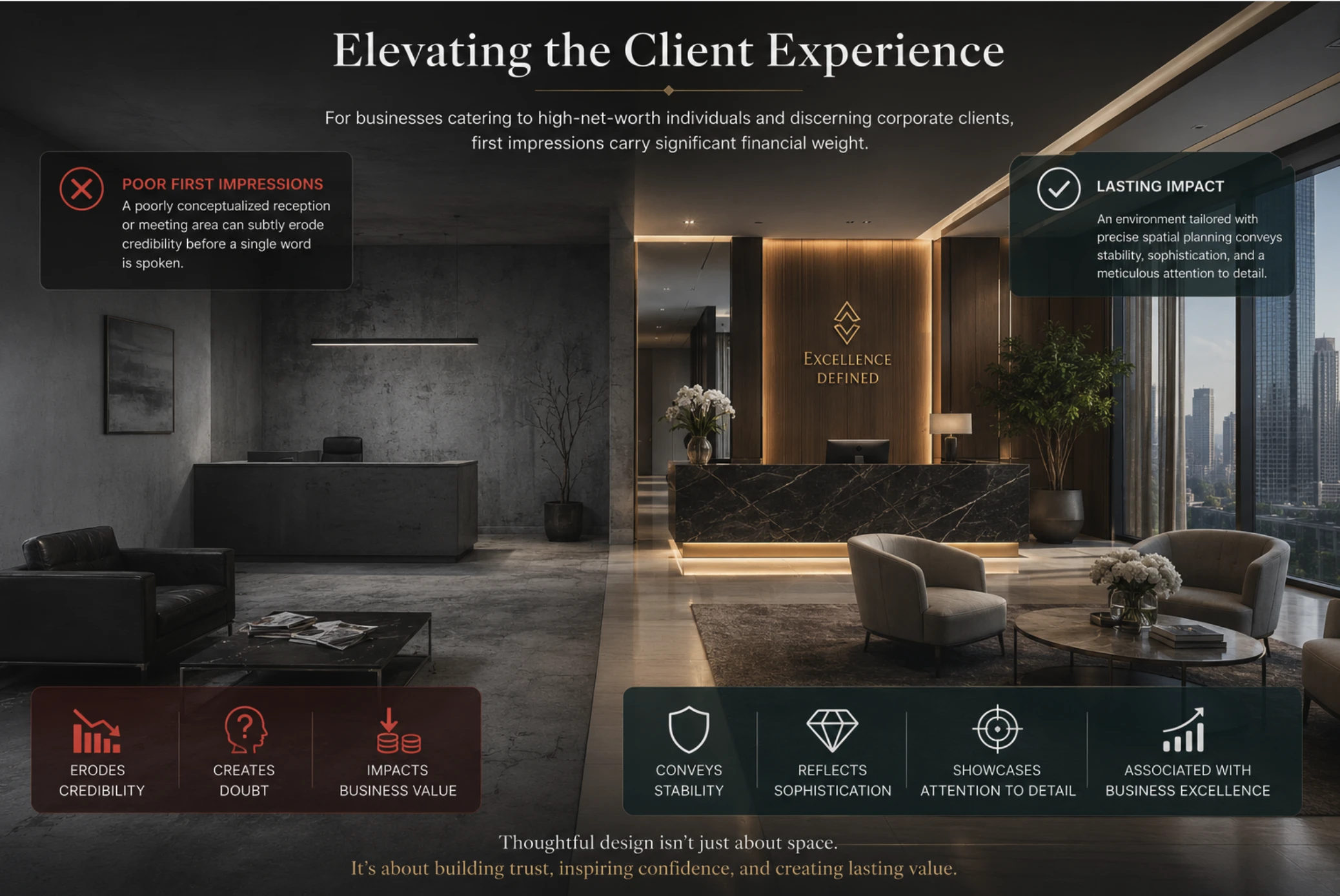
Elevating the Client Experience
For businesses catering to high-net-worth individuals and discerning corporate clients, first impressions carry significant financial weight. A poorly conceptualized reception or meeting area can subtly erode credibility before a single word is spoken. Conversely, an environment tailored with precise spatial planning conveys stability, sophistication, and a meticulous attention to detail—qualities that premium clientele instinctively associates with business excellence.
Spatial Efficiency and Asset Maximization
Commercial real estate is inherently expensive. Professional design ensures that every square meter is maximized for operational efficiency without compromising aesthetic integrity. Proper zoning, intuitive navigation pathways, and sophisticated acoustic management prevent dead zones within a property, ensuring that the entire footprint actively contributes to revenue generation or operational productivity.
Cultivating Brand Equity Through Design Authenticity
In a crowded global marketplace, differentiation is the ultimate competitive advantage. While digital marketing and brand messaging establish an initial connection, the physical environment solidifies a brand’s authority. True luxury and corporate prestige are rooted in bespoke execution—the rejection of off-the-shelf, standardized layouts in favor of tailored spatial identities.
| BESPOKE DESIGN FRAMEWORK | ||
|---|---|---|
| Lifestyle / Work Scenarios Spatial Flow & UX | Material Craftsmanship Premium Execution | Global Turnkey Delivery Full-Cycle Management |
A sophisticated interior integrates timeless design concepts that avoid the pitfalls of transient aesthetic trends. Trends fade quickly, leading to rapid obsolescence and requiring costly capital reinvestments every few years. A timeless commercial space, however, relies on balanced proportions, architectural symmetry, and enduring materials that gracefully age alongside the business.
Craftsmanship as a Statement of Quality
The integration of exclusive interior craftsmanship speaks volumes about a company’s commitment to quality. Custom millwork, masterfully book-matched stone surfaces, and bespoke lighting fixtures are not merely decorative choices; they are tangible assets that signaling permanence and market leadership. When clients observe uncompromised quality in the physical structure of a business, they naturally expect the same standard from the organization’s primary services or products.
Designing for Performance: Lifestyle Scenarios in Commercial Spaces
Residential design focuses heavily on individual comfort, whereas commercial design must account for diverse, collective human dynamics. A successful commercial space accommodates multiple lifestyle scenarios—the specific operational routines, client interactions, and cultural habits unique to that organization.
| HYBRID SPACE UTILIZATION | |
|---|---|
| Private Focused Work | Collaborative Synergy Hubs |
| • Acoustic Isolation • Ergonomic Privacy |
• Integrated Technology • Flexible, Dynamic Layouts |
Optimizing Workplace Productivity
In corporate environments, the return on investment manifests through human performance. Modern workspaces must seamlessly shift between high-focus individual tasks and collaborative synergy sessions. Designing personalized functional interiors requires balancing these contrasting needs:
- Acoustic Isolation: Utilizing specialized wall treatments, acoustic baffling, and strategic layouts to prevent sound bleeding between meeting rooms and quiet workspaces.
- Ergonomic Integration: Specifying premier, ergonomically sound furnishings that reduce fatigue and support long-term physical well-being.
- Biophilic Elements: Integrating controlled natural light, indoor greenery, and natural textures proven to lower stress markers and enhance cognitive function.
The Expert Perspective: Merging Aesthetics with Business Logic
The convergence of luxury residential sensibilities and commercial functionality has altered expectations across both sectors. The standard for commercial spaces is no longer just utility; it is an uncompromised level of comfort and sophistication.
“The distinction between high-end residential environments and commercial spaces has permanently dissolved,” observes Tetiana Oliinyk, founder and lead architect of OLT DESIGN, a studio renowned for its refined portfolio spanning residential interior design in the US and Europe. “Today’s corporate executives and premium commercial clients demand environments that mirror the bespoke comfort and intuitive functionality of a luxury estate. A commercially viable space must prioritize the human element, crafting specific lifestyle and operational scenarios into the physical architecture. When a space feels inherently authentic and effortlessly functional, it creates an environment where people want to stay, work, and invest.”
The Financial Realities of Execution: Turnkey Global Delivery
A flawless conceptual design holds little value if it cannot be executed within budget, on schedule, and up to exact technical specifications. For international enterprises and property developers, the procurement and construction phases present significant operational risk. This reality underscores the necessity of engaging design firms that offer comprehensive, full-cycle project management.
| FULL-CYCLE PROJECT TIMELINE | |||
|---|---|---|---|
|
PHASE 01
Concept Development Mood Boards / 3D |
PHASE 02
Technical Schematics Engineering / HVAC |
PHASE 03
Procurement Global Supply |
PHASE 04
Supervision Site Quality |
The Safety of Full-Cycle Design Management
A specialized commercial studio manages the entirety of the project lifecycle, protecting the client’s financial investment through structured phases:
- Concept and Spatial Strategy: Crafting detailed mood boards, programmatic layouts, and photorealistic 3D visualizations to align the design with business objectives before any capital is deployed.
- Comprehensive Technical Documentation: Developing highly accurate architectural drawings, electrical plans, HVAC integration schemes, and material specifications. This rigorous technical preparation minimizes unexpected variations and costly mid-construction delays.
- Global Supply Chain Procurement: Sourcing premium materials and custom furnishings from vetted international artisans and manufacturers, securing institutional pricing while maintaining quality control.
- Rigorous Design Supervision: Maintaining continuous oversight during the construction phase. Active on-site or remote architectural supervision ensures that general contractors adhere precisely to the approved technical plans and premium finishing standards.
Architectural Capital as a Growth Driver
Every dollar allocated to commercial interior architecture should be viewed as an investment in a tangible corporate asset. By focusing on longevity, functional craftsmanship, and meticulous spatial planning, businesses can unlock substantial financial advantages.
The data surrounding commercial property development consistently demonstrates that high-tier interior architecture directly correlates with enhanced market performance.
| Business Objective | Architectural Solution | Financial & Operational Return |
| Asset Value Optimization | Premium material selection & timeless layouts | Higher lease premiums, increased property valuation, and reduced long-term maintenance costs. |
| Human Capital Performance | Ergonomic optimization & acoustic engineering | Reduced employee turnover, lower absenteeism, and increased daily operational productivity. |
| Brand Differentiation | Bespoke interior identity & custom craftsmanship | Elevated market positioning, increased customer dwell time, and higher average transaction values. |
Ultimately, a commercial property is far more than an enclosure for daily operations. It operates as a continuous representation of a company’s market position, an anchor for corporate culture, and a direct driver of commercial efficiency. Partnering with elite design professionals allows businesses to transform standard square footage into a sophisticated, high-performing corporate asset that pays dividends for years to come.