
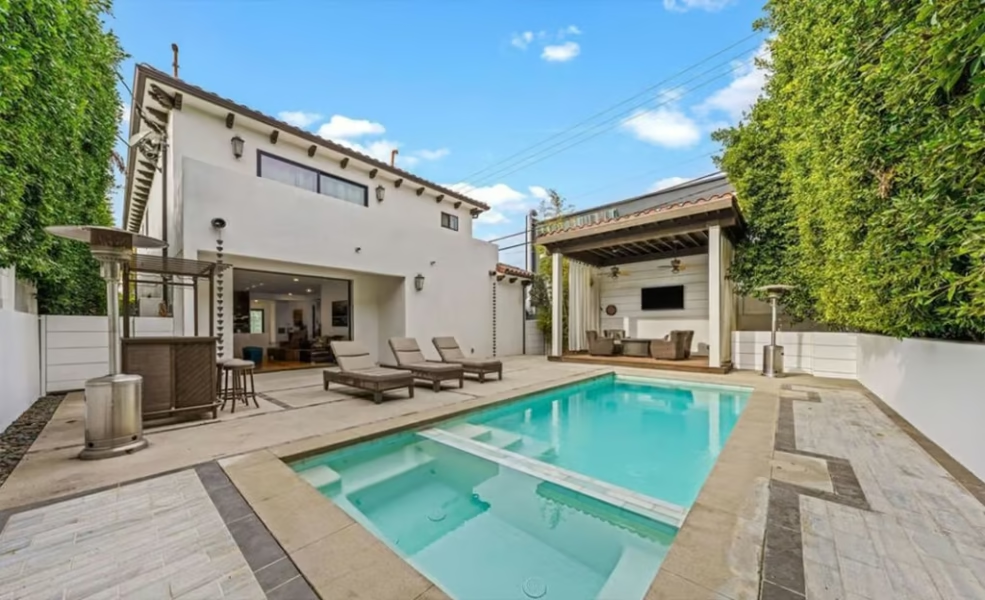
When Twitch streamer Hasan Piker bought a $2.74 million home in West Hollywood in August 2021, the internet erupted. The controversy was immediate and specific: how does one of America’s most prominent socialist commentators justify owning a luxury LA mansion? But beneath the political drama sits a question that matters to me as a design professional: is the house actually well built?
The Hasan Piker house, located in the Beverly Grove neighborhood of Los Angeles, is a 3,800-square-foot Mediterranean Revival residence with five bedrooms and 5.5 bathrooms. Purchased for $2.74 million through agents Ron Wolotzky of Rodeo Realty and Jennifer Okhovat of Compass, it represents a specific tier of LA luxury: new construction with architectural character, not just square footage.
Here is my professional assessment of how this property performs from a design, material, and livability standpoint.
Quick Facts: Hasan Piker’s West Hollywood Home
| Detail | Specification |
|---|---|
| Location | West Hollywood (Beverly Grove), Los Angeles, CA |
| Purchase Price | $2.74 million (August 2021) |
| Size | 3,800 square feet |
| Bedrooms | 5 |
| Bathrooms | 5.5 |
| Year Built | 2014 |
| Architectural Style | Mediterranean Revival / Spanish-style |
| Price Per Square Foot | $721 (at purchase) |
| Key Features | Swimming pool, private courtyard, open-concept layout, vaulted ceilings |
| Buyer’s Agents | Ron Wolotzky (Rodeo Realty), Jennifer Okhovat (Compass) |
The Controversy: Why This House Made Headlines
Before I get into the architecture, the controversy deserves direct acknowledgment because it is why most people are reading this. Hasan Piker is not just a Twitch streamer. He is one of the most visible socialist and anti-capitalist voices on the internet. When news broke that he purchased a $2.74 million home in West Hollywood, the backlash was swift and loud.
As The Guardian reported at the time, critics immediately leveled accusations of “class traitor” and “hypocrite.” The Yahoo News coverage described the online response as Piker’s “perceived class betrayal” unleashing a debate across Leftist Twitter. The core argument from critics: a socialist living in a nearly $3 million mansion represents a fundamental contradiction.
Piker’s defense was equally straightforward. He argued that housing is a basic necessity, that his wealth comes from his own labor as a content creator rather than from exploiting workers, and that owning a home does not disqualify someone from advocating for systemic economic reform. The debate continued for weeks, covered by outlets from Fox News to The Independent.
From my perspective as a design analyst, the political debate is not my lane. But the fact that this house became a cultural flashpoint does shape how we should evaluate it. This is not just a building. It is a property that millions of people have an opinion about. That makes its design choices more visible and more scrutinized than virtually any other home at this price point.
The Architectural Identity: Mediterranean Revival in Beverly Grove
The home’s Mediterranean Revival style is immediately recognizable from the street. White stucco walls and terracotta roof tiles create the classic Spanish-influenced silhouette that defines much of West Hollywood’s residential character. Built in 2014, the property sits in that interesting gap between authentic period architecture and modern builder interpretation.
From a materials perspective, the stucco exterior is a practical choice for Southern California. Stucco provides genuine thermal mass benefits, absorbing heat during the day and releasing it slowly at night, which moderates interior temperatures. In a climate where air conditioning costs can be significant, this is not just aesthetic. It is functional design.
The terracotta roof tiles serve a similar dual purpose. Clay tile roofs routinely last 50 to 100 years in dry climates, far outperforming asphalt shingles. They also provide superior insulation compared to standard roofing materials. For a home built in 2014, these are authentic material choices rather than cosmetic imitations, which speaks to the builder’s commitment to architectural integrity.
Room-by-Room: The Key Spaces That Define This Home
The Kitchen: The Heart of the Open Floor Plan
In a home where the owner streams for eight-plus hours daily and regularly hosts guests, the kitchen carries outsized importance. The open-concept layout places the kitchen as the visual anchor of the main living floor, with sight lines extending into the living area and outward toward the pool. This is the configuration that makes 3,800 square feet feel like 5,000.
Based on publicly available tour footage, the kitchen features a substantial center island, consistent with 2014 new-construction standards at this price tier. The countertops appear to be granite or quartz, with frameless cabinetry and stainless appliances. These are durable, functional choices rather than aspirational ones. The island doubles as a casual dining surface, which is how kitchens in homes like this actually get used during a long streaming day.
The Primary Suite: The Private Retreat
The primary bedroom occupies its own wing upstairs, which is the layout decision I would single out as most impactful in this floor plan. Separating the primary suite from the other bedrooms creates genuine privacy in a home that doubles as a broadcast studio. When Piker is streaming from the dedicated studio room, the distance between that space and the primary suite means the bedroom stays acoustically isolated.
The en-suite primary bathroom follows the 5.5-bath logic: every bedroom gets its own. For the primary suite specifically, this means a full bathroom with double vanity, separate shower, and soaking tub as standard for 2014 Mediterranean construction at this price point. The bathroom finishes, like the kitchen, reflect the builder-grade-to-mid-tier range that characterizes homes at $721 per square foot.
The Lion King Bedroom: Personalization Meets Fun
This is the room everyone asks about. During a widely viewed house tour with streamer QTCinderella, Piker revealed a safari-themed bedroom decorated with Lion King memorabilia. The internet loved it. From a design perspective, this room illustrates something important about how a house becomes a home.
The Lion King bedroom is not a design statement. It is a personality statement. And in luxury real estate, that distinction matters. Homes that reflect genuine personal taste, even when that taste is unconventional, create stronger emotional connections than homes that read as showrooms. Piker has since noted in clips that he limits what he shows on camera, keeping most of the house private. That restraint is itself a design choice: the home serves the owner, not the audience.
The Streaming Studio: The Fifth Bedroom as Broadcast Hub
One of those five bedrooms functions as a dedicated broadcasting studio. This creates specific requirements: sound isolation from the rest of the house, controlled lighting conditions, and adequate ventilation for equipment that generates significant heat over eight-hour streaming sessions.
A 2014-built home with modern insulation standards and solid-core interior doors can reasonably achieve the sound isolation needed. Piker has updated his streaming setup multiple times since moving in, as documented in clips showing room rearrangements. The 5-bedroom layout means the studio does not compromise guest accommodations, which is a genuine advantage over homes where a creator must choose between a functional workspace and hospitality.
Security and Privacy: The Streamer’s Most Critical Feature
Any analysis of a high-profile streamer’s home that ignores security is incomplete. Hasan Piker has been repeatedly doxxed and swatted, incidents he has discussed publicly on stream. In 2021, shortly after the purchase, his home address was leaked despite his efforts to keep it private. The swatting that followed, where someone calls armed police to the house based on a false report, is a real and dangerous pattern that affects many prominent streamers.
This is not a peripheral concern. It is a primary design consideration. For a property like this, the security evaluation starts at the perimeter. The private courtyard that I praised earlier for its aesthetic function also serves a critical security function: it creates a buffer zone between the street and the interior. A gate-controlled entry point, even a modest one, provides the first layer of access control.
The white stucco wall that defines the property line does double duty. Aesthetically, it reads as Mediterranean Revival. Functionally, it blocks direct sight lines from the street into the courtyard and pool areas. For a streamer who broadcasts daily, the ability to control what is visible from outside is not a luxury. It is a safety requirement.
Inside the home, Piker has been notably careful about what appears on camera during streams. In TikTok clips, he has acknowledged that most of the house stays off-limits from the camera, with only select areas like the kitchen and his streaming room appearing regularly. This camera discipline is itself a form of security design: controlling the visual information available to viewers reduces the risk of further privacy violations.
Material Quality: Builder-Grade or Better?
This is the question I get asked most about homes in this price range. A $2.74 million purchase in 2021 at $721 per square foot sits below the ultra-luxury threshold of $1,000+ per square foot that typically guarantees premium finishes throughout.
The hardwood floors visible in public tour footage appear to be engineered oak or similar species, which is standard for new construction in this tier. Engineered hardwood offers dimensional stability in LA’s dry climate where solid hardwood can shrink and gap. The kitchen and bathroom finishes align with what I would expect at this price point: granite or quartz countertops, frameless cabinetry, and fixtures from recognizable mid-tier brands. These are durable and visually coherent, not bespoke artisan installations.
The Indoor-Outdoor Transition: Where LA Luxury Lives or Dies
In West Hollywood real estate, the indoor-outdoor transition is not a bonus feature. It is the defining feature. The Piker property includes a private courtyard and a swimming pool. The courtyard operates as a transitional zone between the street and the interior, providing privacy in a neighborhood where lot sizes are compact and homes sit close together.
The pool area serves as the outdoor living room. Mediterranean-style homes typically use French doors or sliding glass walls to connect interior and exterior spaces. The quality of these openings matters enormously. Properly installed systems with quality weatherstripping make the difference between a space you use and a space you admire from inside. The privacy landscaping around the pool, combined with the stucco perimeter wall, creates a secluded compound feel in a dense urban neighborhood.
Inside the Home Today: Decor and Personalization Since 2021
It has been several years since Piker moved in, and the house has evolved from its original builder-finish state. Public clips and social media posts reveal a home that has been gradually personalized rather than professionally staged. The streaming room has undergone multiple setup changes, reflecting the iterative nature of content creation spaces where equipment needs shift over time.
The overall decor leans casual and functional rather than curated. This is consistent with how most people actually live, but it contrasts with the polished interiors typically featured in luxury real estate content. For visitors expecting a magazine-spread mansion, the lived-in reality may feel surprisingly normal. That normalcy is, in my professional opinion, a strength. Homes that prioritize daily comfort over aesthetic perfection tend to perform better as long-term residences.
Nyla’s Real-World Living Score
After evaluating the property across architectural integrity, material quality, spatial design, security, and long-term livability, here is my assessment.
Architectural Integrity: 8/10. The Mediterranean Revival style is executed with genuine materials and coherent design language. The stucco and terracotta are authentic, not vinyl imitations.
Material Quality: 7/10. Solid for the price tier. The 2014 construction benefits from modern building codes and waterproofing standards. Finishes are durable mid-range rather than premium.
Spatial Design: 8/10. The 5-bed, 5.5-bath en-suite configuration is highly functional. The open-concept main floor and the private courtyard both serve the LA lifestyle. The streaming studio is well-supported by the layout.
Security and Privacy: 7/10. The courtyard, perimeter walls, and camera discipline provide meaningful protection. However, the Beverly Grove location, with its compact lots and proximity to neighbors, presents inherent challenges that no single-property design can fully overcome.
Long-Term Value: 8/10. Beverly Grove remains one of LA’s most stable residential markets. As of recent data, the median sale price in the area is approximately $1.7 million with price per square foot near $790 to $880. The Piker home was purchased at $721 per square foot in 2021. Despite recent softening in the broader West Hollywood market, where median prices have declined roughly 15% year-over-year as of March 2026, properties with architectural character and functional layouts tend to hold value better than generic new builds.
Maintenance Considerations: Pool upkeep, white stucco cleaning, and terracotta tile inspection are ongoing costs. Budget approximately $8,000 to $12,000 annually for exterior maintenance alone in the LA climate.
