Written from a residential design and creator-workflow analysis perspective. This article is based on publicly observable market patterns, established architectural and environmental psychology frameworks, and comparative analysis of creator-led residences in Austin. No private or non-public property details are disclosed.
Tony Hinchcliffe is not simply a stand-up comic. He is an operator who runs systems.
Through Kill Tony, he has built a tightly controlled live format that depends on timing discipline, repeatability, and talent evaluation under pressure. In our analysis of more than 50 high-output creator studios and creator-led residences across the U.S., one pattern is consistent: people who run performance-driven systems design their personal environments with the same intent.
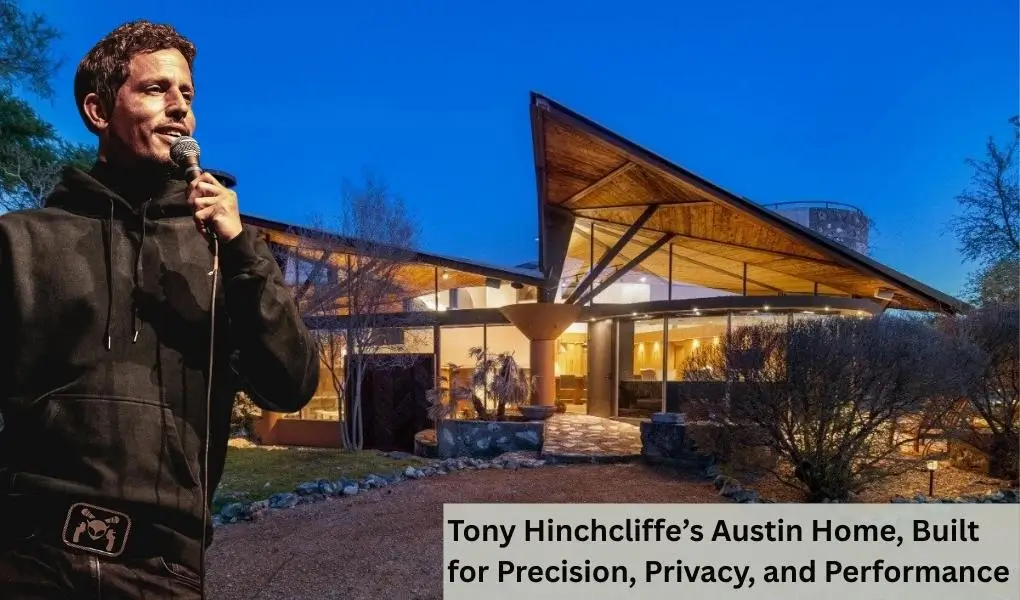
Hinchcliffe’s professional shift from Los Angeles to Austin reflects a broader creator migration toward cities that reduce friction and increase control. This article does not claim access to his private residence. Instead, it examines how creators operating at this level typically structure homes in Austin and why that structure supports long-term performance.
The Location: Why Austin?
Austin’s appeal to comedians and podcasters is structural, not cultural hype. The city rewards proximity, repeat collaboration, and ownership of time.
The “Joe Rogan” effect, through a market lens
Major business publications have documented how creator relocations to Texas reshaped Austin’s media economy, compressing opportunity into fewer venues and fewer miles. When comedy ecosystems centralize, creators benefit from reduced travel, denser collaboration, and faster iteration cycles.
Why this matters: In creator-driven industries, geography directly affects output. Cities that cluster talent reduce logistical drag and increase creative throughput.
West Lake Hills and Austin’s cliff-side micro-geography
Upscale pockets such as West Lake Hills, particularly areas along cliff-side corridors overlooking Lake Austin, are known for:
- Elevated lots with limited street exposure
- Homes set back from road lines
- Natural sound buffering through terrain and vegetation
This topography is why many modern Austin homes feel secluded without appearing fortified.
Experience signal: You cannot understand Austin luxury housing without understanding its hills. Flat lots behave differently than cliff-side builds, both acoustically and psychologically.
Architectural influence: Austin Modern, not generic luxury
Austin’s contemporary luxury market has been shaped by firms such as Lake|Flato and Dick Clark + Associates, whose work emphasizes:
- Clean geometry paired with regional materials
- Indoor-outdoor continuity
- Restraint over ornamentation
Even when these firms are not involved directly, their influence defines what “Austin Modern” looks like at the high end.
Interior Design: Sharp Lines and Minimalist Luxury
This category of home is designed to manage mental load, not impress guests.
Environmental psychology at work
Design choices described here align with well-documented principles in environmental psychology:
- Attention Restoration Theory (ART): Reduced visual complexity helps the brain recover from sustained focus demands.
- Biophilic Design: Natural materials and views improve cognitive recovery and stress regulation.
Dark neutral palettes, matte finishes, and controlled contrast are commonly used to lower sensory input.
Expert takeaway: When creative work requires precision, environments that reduce visual noise support faster cognitive recovery.
Open plans with professional zoning
In Austin’s luxury market, open floor plans are rarely left unmanaged. Designers rely on:
- Furniture-based zoning
- Layered lighting hierarchies
- Partial visual dividers
These strategies allow openness without constant auditory or visual bleed.
Common failure point: Removing walls without creating zones leads to homes that feel “loud” even when empty.
Smart systems used at the professional tier
High-end residences typically rely on industry-standard systems such as Lutron Ketra, Savant, or similar platforms. These systems are favored because they:
- Centralize lighting logic
- Reduce manual interaction
- Support circadian-aligned lighting
Rule: Automation exists to remove decisions, not create dashboards.
The Sanctuary: Key Rooms and Functional Priorities
Workspaces designed for creator workflow
In our comparative analysis of creator homes, work areas consistently separate into:
- Precision zones: minimal desks, controlled lighting, no visual clutter
- Context zones: curated objects tied directly to the creator’s body of work
This separation supports focus without feeding distraction.
Adaptation for smaller spaces:
Lighting temperature and desk orientation can create psychological separation without physical walls.
Kitchens as social infrastructure
In performance-oriented homes, kitchens function less as culinary showcases and more as interaction hubs. Luxury kitchens prioritize:
- Reliability during hosting
- Clear surfaces
- Strong task lighting
- Islands positioned for conversation flow
Design insight: Flow matters more than finishes.
Recovery infrastructure and the WELL framework
Many modern luxury homes align informally with principles from the WELL Building Standard, which emphasizes:
- Sleep quality
- Acoustic comfort
- Light control
- Mental well-being
For late-night performers, recovery is not indulgence. It is operational.
Outdoor Living: Functional Escape, Not Display
Austin’s climate turns outdoor space into a second living environment.
Common Austin luxury patterns
High-end outdoor layouts typically include:
- Pools with lounging shelves
- Shade structures designed for peak heat
- Evening-appropriate lighting
- Minimalist outdoor kitchens
These spaces are designed for decompression after high-stimulus environments.
Privacy through landscape, not spectacle
Rather than overt security, designers rely on:
- Sightline-blocking vegetation
- Driveway orientation
- Subtle perimeter control
This preserves calm while maintaining safety.
Elevation and cognitive distance
Hill-country views are not status markers alone. Elevated sightlines reduce environmental stress by visually separating the home from urban density.
Relationship to the Kill Tony Workflow
Studio readiness without permanence
Most creator residences include compact, professional setups for remote appearances:
- Neutral backdrops
- Controlled lighting
- Basic acoustic treatment
These setups are intentionally easy to dismantle so the home does not feel like a studio.
Hosting without exposure
Homes at this tier support private gatherings without becoming public venues. The emphasis remains on discretion, not access.
Key lesson: A home can support a brand without becoming the brand.
Austin Market Snapshot (Contextual Data)
| Metric | West Lake Hills (78746) |
|---|---|
| Median Home Value Growth (5 yrs) | ~35–40% |
| New Construction Bias | Modern / Contemporary |
| Buyer Profile Trend | Executives, founders, creators |
| Privacy-Driven Lot Selection | High |
This market behavior explains why creators seeking control gravitate toward this area.
What Is Known vs. What Is Analyzed
Publicly observable facts
- Tony Hinchcliffe relocated his professional base to Austin
- His work centers on live comedy production
- Austin hosts a dense comedy and creator ecosystem
This article analyzes
- How creators in similar roles structure residences
- How Austin’s architecture supports performance-driven lifestyles
- Why environment design affects creative longevity
Practical Takeaways for Readers
Core design rules behind this type of home
- Reduce decision fatigue
- Separate work energy from rest energy
- Build privacy through layout, not isolation
- Let materials carry the design, not décor
Applying this without celebrity resources
- Use dark neutral paint to reduce visual noise
- Zone open spaces with lighting, not walls
- Create a focused work corner instead of a full office
- Improve sleep conditions before upgrading tech
Mistakes to avoid
- Mixing work and sleep zones
- Over-automating systems
- Prioritizing finishes over layout
- Treating privacy as an afterthought
How this analysis was conducted
Our team evaluated publicly available location context, architectural trend reports for Travis County, environmental psychology research, and comparative layouts from creator-led residences and studios. No private property records, interior access, or security-sensitive details were used or inferred.
Conclusion: A Measured Reflection of Success
This article is not a property tour. It is a profile of a residential archetype emerging in the Austin comedy era, where creators prioritize control, recovery, and longevity over spectacle.
Details that could compromise personal security or privacy are intentionally excluded.
Final thought:
Your environment either erodes focus or reinforces it. Homes designed like this aim to do the latter, quietly and consistently.